

Enclosed utility task vehicles typically refer to electric utility task vehicles equipped with a soft enclosure, rather than a fully enclosed body. This design, using removable rain curtains or transparent side panels, provides basic wind and rain protection without altering the cart’s structure, making it the most cost-effective solution for golf courses and resorts.
Compared to fully enclosed models, soft-enclosed utility task vehicles are more flexible, economical, and better suited to the operational needs of most golf courses.
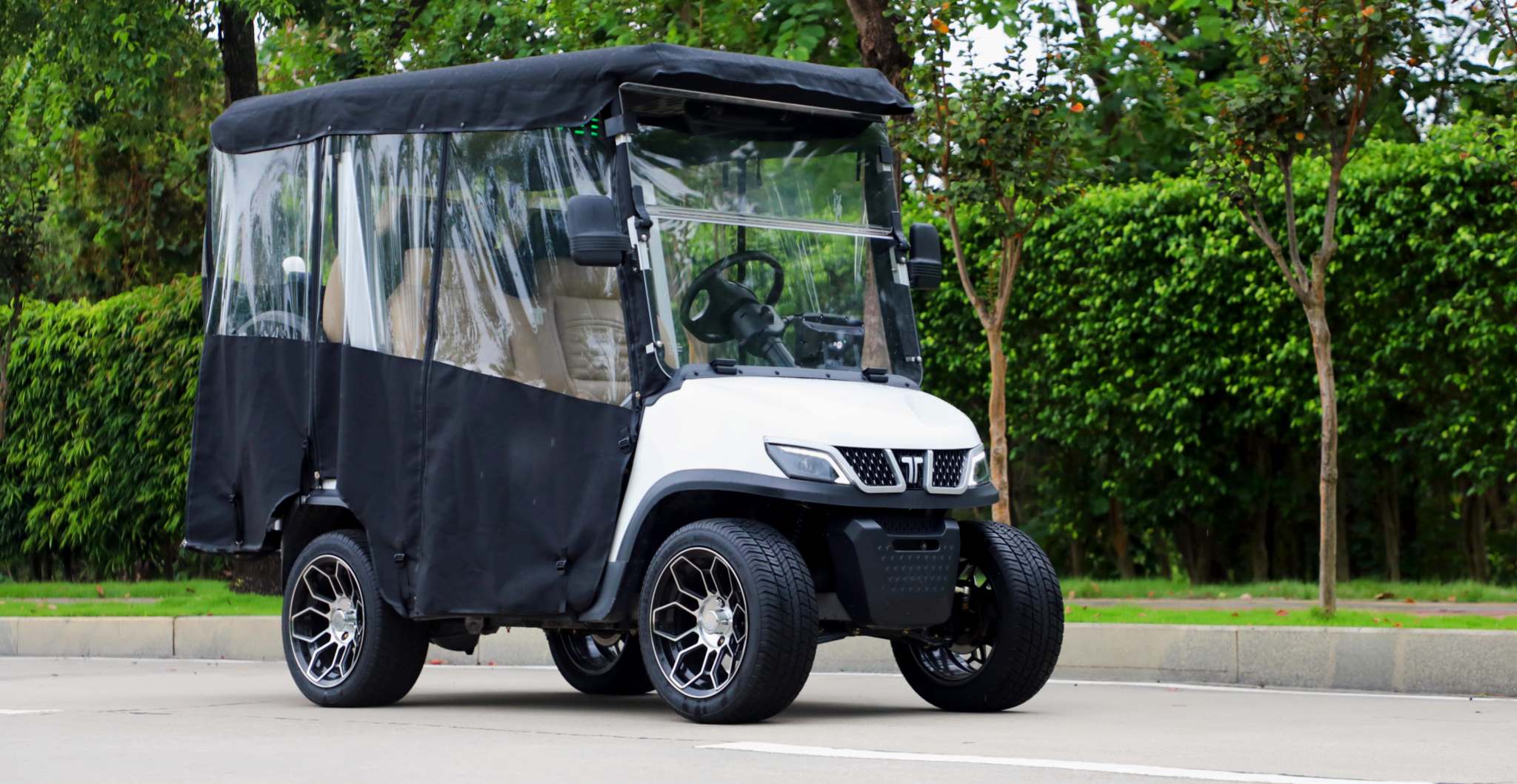
What are Enclosed Utility Task Vehicles?
From a product structure perspective, soft-enclosed utility task vehicles do not involve adding a rigid cabin; rather, they achieve protection through an accessory system.
The core features include:
Transparent PVC side curtains (zippered enclosure)
Roll-up or removable door curtain design
Extended canopy structure
Rear windproof curtain
These components can be flexibly adjusted according to weather conditions, allowing electric utility task vehicles to maintain good adaptability in various environments.
Why are soft-enclosed utility task vehicles better for golf courses than fully enclosed ones?
For most golf courses, fully enclosed vehicles are not the optimal choice, while soft-enclosed utility task vehicles are more in line with practical operational logic.
Higher Flexibility
They can be fully opened on sunny days to maintain an open experience; they can be quickly closed in rainy weather.
More Controllable Costs
Upgrades can be made simply by adding an enclosure, without replacing the entire cart.
Simpler Maintenance
No complex structural maintenance is required, and parts are easier to replace.
No Impact on the Course Experience
Maintaining the openness of golf is a crucial factor for many courses.
Therefore, nationwide, most utility task vehicle fleets prefer soft-enclosed solutions.
Practical Upgrade Solutions for Electric Utility Task Vehicles
From a procurement perspective, soft-enclosed utility task vehicles are more like a “functional extension” of electric utility task vehicles than a completely new model.
Typical applications include:
Installing enclosures directly on new carts
Adding enclosures to existing fleets
Adjusting the enclosure according to the season
This approach not only reduces initial investment costs but also makes the utility task vehicle fleet more flexible.
How to Properly Configure a Utility Task Vehicle Fleet?
In actual operation, it’s typically necessary to prepare enclosed kits for about 30% of the total number of utility task vehicles, allowing for rapid deployment in rainy weather.
This structure ensures cost control while improving overall service capabilities.
Difference Between Utility Vehicles and Enclosed Utility Task Vehicles
It’s important to note that utility vehicles and enclosed utility task vehicles have completely different uses.
Utility Vehicle:
Used for cargo and operations. Emphasizes functionality and load-bearing capacity.
Enclosed Utility Task Vehicles:
Used for personnel transport. Emphasizes comfort and experience.
Combining both is essential for building a complete course operation system.
Which Scenarios Require Enclosed Utility Task Vehicles Most?
Enclosed utility task vehicles are particularly suitable for the following scenarios:
Rainy Areas
For regions like the Pacific Northwest and the Southeast, where weather changes frequently.
Year-Round Courses
Need to cope with spring and autumn rains and cold winter winds.
Resorts and Hotels
Enhance the customer experience in less than ideal weather.
Commercial and Tourist Venues
Ensure operations are unaffected by weather.
These scenarios have a strong need for flexible protection, which soft enclosure solutions perfectly match.
Frequently Asked Questions (FAQ)
Are Enclosed Utility Task Vehicles the same as fully enclosed vehicles?
No. In most practical applications, enclosed utility task vehicles refer to soft enclosures, not rigid, fully enclosed bodies.
Will soft enclosures affect the driving experience?
Not significantly. High-quality enclosure designs balance visibility and ventilation, achieving a balance between protection and experience.
Can it be retrofitted?
Yes. Most electric utility task vehicles support the retrofitting of soft enclosure systems, offering a flexible upgrade option.
What is the lifespan?
Depends on materials and usage environment. High-quality PVC enclosures maintain good durability under normal use.
Equipment Logic
In modern golf course operations, vehicles are not just transportation but also part of the service experience. Soft enclosures allow electric utility task vehicles to adapt to more weather conditions and scenarios in a low-cost, highly flexible way. By combining a well-planned utility task vehicle fleet with utility vehicles, golf courses can significantly improve operational stability and customer satisfaction while controlling costs.
For courses that want to improve service quality without a substantial increase in investment, enclosed for utility task vehicles is currently the most realistic and efficient solution.
Post time: Apr-10-2026