

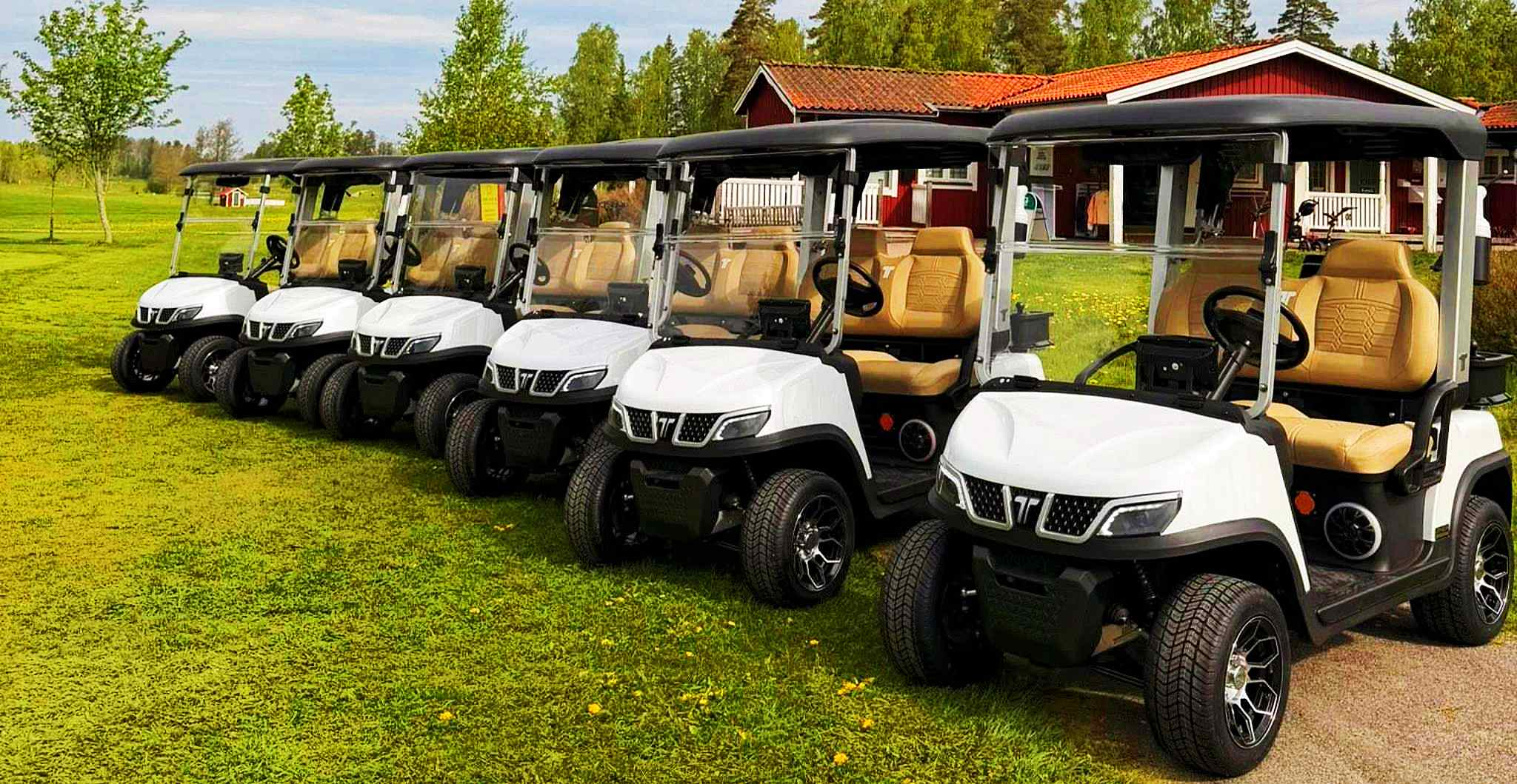
For most golf courses, two-passenger utility task vehicles remain the most common and widely used vehicle type. From daily play and member reception to tournament operations, two-seater carts, with their flexible handling and high efficiency, are an essential part of the course fleet.
While four-seater and multi-seater models are increasingly available, two-passenger utility task vehicles remain the preferred choice for building utility task vehicle fleets for standard 18-hole courses and are the first choice for clubs upgrading their fleets.
Built for Daily Play
Golf is typically played with two people sharing a cart, so two-passenger utility task vehicles perfectly meet daily operational needs.
Compared to larger vehicles, two-seater carts are more compact, allowing for greater maneuverability on fairways and cartways, and easier parking and dispatching. For courses, this translates to higher vehicle utilization and reduced unnecessary operating costs.
For larger fleets, using two-passenger utility task vehicles uniformly also helps simplify maintenance and parts management.
Lithium Is the New Standard
In recent years, an increasing number of golf courses have begun purchasing Lithium Utility Task Vehicles.
Compared to traditional lead-acid batteries, lithium-ion batteries offer shorter charging times, longer lifespans, and significantly reduced routine maintenance. For utility task vehicle fleets that operate continuously every day, these advantages effectively reduce operating costs.
Therefore, lithium-ion battery technology has become a crucial factor in the procurement of Two Passenger Utility Task Vehicles.
GPS Makes Fleet Management Easier
Modern golf courses are not only focused on the vehicles themselves but also increasingly emphasizing fleet management.
Through a utility task vehicle GPS system, managers can monitor vehicle location, battery status, and operational status in real time, and combine this with geofencing for more scientific vehicle scheduling.
For courses with dozens or even hundreds of Two Passenger Utility Task Vehicles, the GPS system not only improves management efficiency but also helps protect the greens and optimize vehicle usage.
Why Tara
Tara specializes in utility task vehicles and has over twenty years of industry experience. Currently, hundreds of golf courses and clubs across the country are using TARA Utility Task Vehicles (UTV).
Whether it’s the classic two-seater or the Tara Harmony equipped with a caddie stand, both utilize a mature platform design and incorporate advanced Lithium Utility Task Vehicle technology to provide courses with a stable and reliable daily operational experience.
In addition to complete vehicles, Tara also offers a professional Utility Task Vehicle GPS management system, enabling vehicle positioning, geofencing, battery monitoring, and operational data analysis, providing a complete intelligent management solution for modern Utility Task Vehicle Fleets.
FAQs
What are Two Passenger Utility Task Vehicles used for?
Two Passenger Utility Task Vehicles are primarily used for daily operations on golf courses, suitable for two players to ride together, and are currently the most common vehicle type used on courses.
Why do golf courses choose Lithium Utility Task Vehicle models?
Lithium Utility Task Vehicles offer longer battery life, faster charging speeds, and lower maintenance requirements, helping courses reduce long-term operating costs.
Can Utility Task Vehicle GPS improve fleet management?
Yes. Utility Task Vehicle GPS helps courses manage vehicle location, battery status, and usage in real time, improving the overall operational efficiency of the Utility Task Vehicle Fleet.
Why choose Tara Two Passenger Utility Task Vehicles?
Tara boasts over two decades of industry experience, with its products serving hundreds of golf courses and clubs across the country. It offers Lithium Utility Task Vehicle technology and Utility Task Vehicle GPS intelligent management solutions to meet the long-term operational needs of modern courses.
Post time: Jul-23-2026